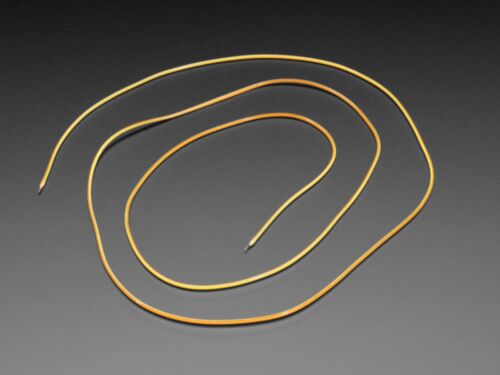
Hey there, @Rohit333898, and welcome to the forum. Glad to have you here.
I’d be very cautious about scaling these using fourteen of these. You could power all fourteen 1.2 m nOOds from one supply, connected in parallel, rather than end-to-end electrically, but at 24V that will draw 1A and Adafruit have noted that it can get quite warm.
Running them slightly undervolted, around 22–22.5 V, would reduce current and heat, but each filament would still be drawing 500 mA, so it would be around 168W to power them all. This would not be a straightforward connect-them-all-to-one-supply project.
I’d hold off buying parts for this approach. What are you making, and do you need the thin, flexible filament look? A photo or sketch would help identify a simpler, safer lighting approach.
Thanks for the heads-up. To clarify the design: I’m not planning to run them at 24V direct or at the 500 mA limit. Each of the 14 strands will have its own series resistor (15 Ω, 1 W) to hold it around 150–200 mA, giving roughly 2.6 A / 65 W total from a single 24V 3.75A supply, all strands wired in parallel. It’s a 1.2 × 1.2 m hanging grid chandelier in open air, not enclosed.
Before ordering all 14, I’d like to buy one ADA5732, one 24V 3.75A supply (CE08384) and a 15 Ω 1 W resistor to test current, heat and brightness. Does that approach look sound to you, or would you recommend constant-current drivers per strand instead?
No worries, that sounds like a much better approach than what I originally envisioned. I’d proceed with your single-strand resistor-limited test rather than buy constant-current drivers at this time. Adafruit recommends resistor limiting, and 15 Ω looks likely to give roughly 180–190 mA from its published figures, though temperature and strand variation mean you’ll need to measure it.