That would be a useful comparison and these devices are not that expensive. These devices are usually a small fan where the relationship between fan pitch, RPM and actual wind speed are more direct.
Your anemometer with the 3 arms with hemispheres on the end is a little more complex. While you have one “cup” with the wind you have the other 2 against the wind, all at varying degrees of “conductance” or “resistance” for want of a more descriptive term. Thus there are a few factors between the actual wind speed and RPM which hopefully are taken care of with the on board electronics. This may be why such a simple looking device is a bit more expensive than one would expect.
Cheers Bob
Add on: There would probably be many discussions re this on google.
Wikipedia has a good cover on this topic at
Interestingly it says the modern 3 cup instrument has an error of less than 3% up to about 97km/hr
It does not go into the precise maths here but is a good general description of different anemometers.
Hi all - I just wanted to let you all know that in response to Jane’s helpful post I realised that I had the incorrect modbus addresses specified in my configuration. A good lesson for me in documenting my work as I go and not doing things from memory! Thank you for your patience and assistance. I can now definitively say that I have a working weather station. Once I’ve finished tinkering I will post the configuration somewhere for others. (Bob - I will keep in mind a manual test as I will be very interested to see how accurate the instrument is over time.)
A lack of documentation is truly the most dangerous part of any project. I have fallen to it myself many times.
I’m so glad to hear that you have gotten it working. As a girl with a rain gauge in her backyard, I look forward to seeing your Weather Station configuration.
Hi Jane
When I was working full time it was a common belief that a project was not complete until the weight of the documents equalled the weight of the project. Came close most of the time.
Cheers Bob
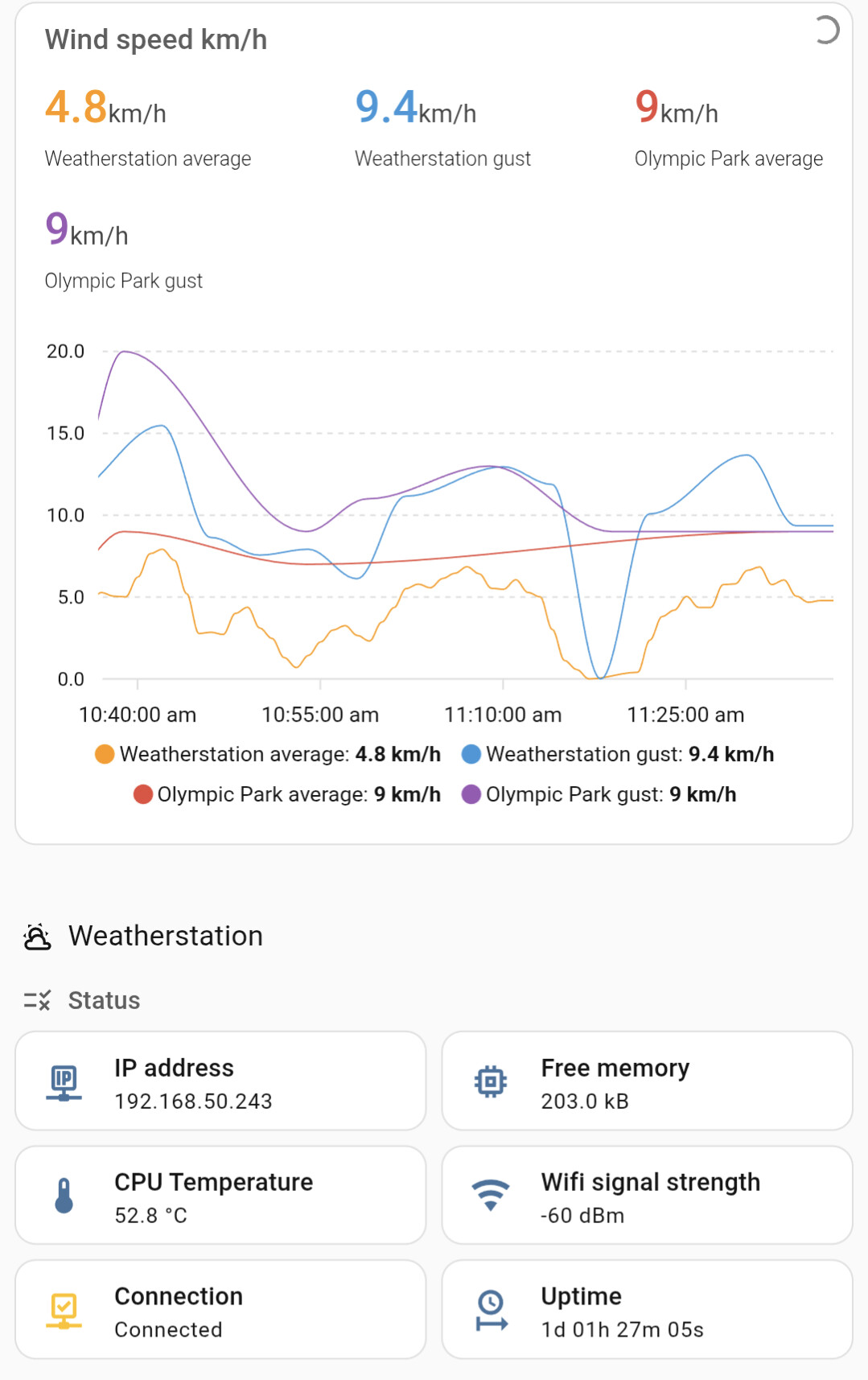
I’ve attached details of my weatherstation including my esphome yaml and some images from Home Assistant (I have a separate integration that pulls local BOM data which you can see in the graphs).
This project started as an 80th birthday present for my father. The idea was to build a weatherstation from components that could be customised and easily repaired. It’s definitely more expensive than an off the shelf kit in case anyone is wondering.
The current components are as follows:
ESP32
BME280 for temperature, humidity and pressure (on i2c)
Tipping bucket rainfall sensor (DFROBOT SEN0575) (on i2c)
Wind speed and wind direction sensors as mentioned in my earlier posts (SEN0483 and SEN0482) on RS485 and connected to Active Isolated RS485 to UART (DFR0845) (note one of the slave addresses needs to be changed for the wind sensors to work together).
Three analogue raindrop sensors connected to a multiplexer - this is to detect rainfall before it registers in the guage (so I can automatically close our awning).
The next additions will be an LTR390 UV sensor (DFROBOT SEN0540) and Sensirion particulate sensor (SEN50). Both i2c devices. I think that will be enough for one ESP32 to handle.
The BME280 worked immediately with esphome as did the multiplexer and rain sensors. The other sensors needed a lot of research including referring to dfrobot libraries for Arduino IDE (where they existed), the wiki pages and also just working out how the sensors needed to be connected took some time (eg I haven’t daisy chained devices for a while). For reference I also replaced the wind sensor cables with twisted pair and added a termination resistor (120 ohm) to the final modbus device. I’m not sure if that was absolutely necessary or not.
I have to admit that most of the code was written with AI assistance. I will at some point teach myself how to code properly, but I haven’t yet. The AI was relatively useful. Some of the ‘chats’ I had were very long and eventually the AI just breaks or worse starts straight out lying to you after a while. If anyone is proposing to do something similar my recommendation is to be aware of their limitations, including what information the tool has access to, and sense check what it’s saying. And if it suggests writing novel or custom code where a pre-built module may do go with the pre-built module. You can certainly waste a lot of time going down rabbitholes you don’t need to go down.
I hope someone finds this useful in future as a reference. The code is almost fully self contained in esphome. I didn’t have to write template sensors in Home Assistant except for the prevailing wind direction.
I thought I would share my final config as the dfrobot LTR sensor was much more difficult to integrate than expected. The “standard” esphome integration which I believe works with the adafruit and other generic models does not work for the dfrobot sensor. It was necessary to refer to the dfrobot library and wiki to get it to work. This sensor needs a bit of calibration to ensure it is outputting reasonable values. I have the sensor in a box under clear plastic in direct sunlight.
Here is the full text. I hope it is useful to someone who is facing similar issues in future.