
Hi Pix
No No No.
I don’t know exactly what you intend to do with this but certainly DO NOT connect the output (pin 3) to ground. I don’t know but it might destroy the 555. It certainly won’t do it any good.
Cheers Bob
1 Like
By the way, did you ever get that flip flop circuit to work.
I posted 4 days ago about my thoughts on that.
Please don’t join the brigade of people who don’t see fit to report results.
Cheers Bob
1 Like
Ohh good point.
Its going through a multimeter to ground… but it needs a diode there to protect the 555 timer!
Ill add it in soon
I did get it to work but as you predicted the led was a poor indicator. It would either be off or on. I.e. by the time i could get the led to illuminate at all the transistor was practically saturated and the potentiometer made next to no difference.
Hence why ive changed tack to a 555 timer circuit so i can measure the frequency instead and i can meausre if i was successful.
No its not. You have it connected directly to ground and for some unexplained reason the probe connected to that. If you want to measure anything connect a resistor from pin 3 to ground and connect your multimeter to pin 3
Cheers Bob
PS: At 500nF I don’t think C1 will be a polarised electrolytic capacitor.
Hi Pix
If you are just after an indication of what state the flip flop is in here is a quick circuit that is as simple as you will get.
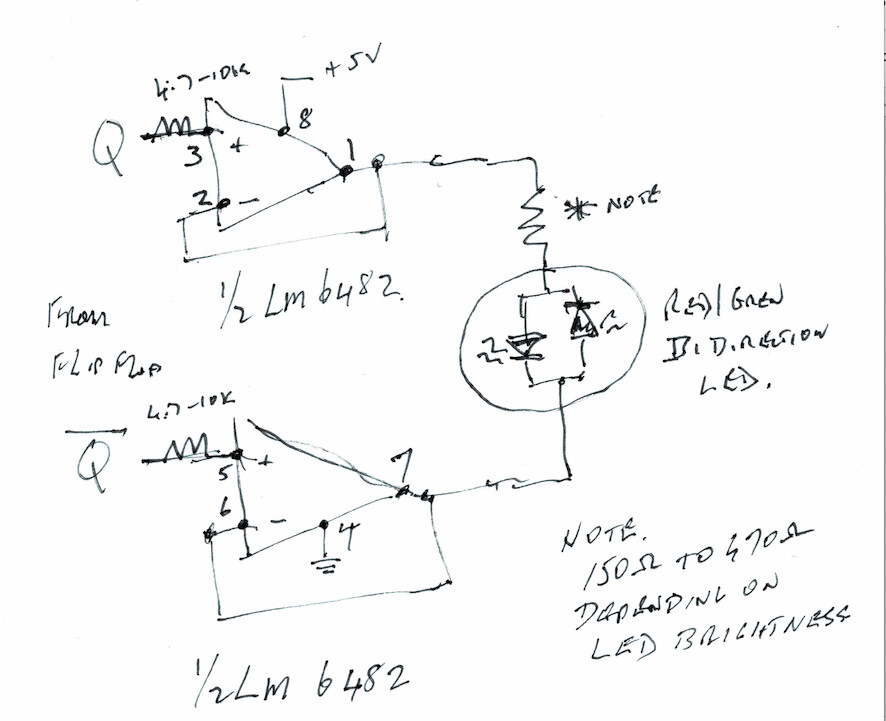
The Op Amp is a common rail to rail. Non rail to rail Op Amps will not swing to 5V and ground.
I would suggest resistor value between 270Ω and 330Ω which will give a LED current of about 10mA which is within Op Amps capability.
Cheers Bob
The Op Amp and LED (3mm and 5mm) are available from Jaycar if that is more convenient.
3 Likes
Pix,
To achieve a varying LED brightness you could use one of the LM3914/5/6 series. The IC turns on different outputs pins for varying voltage inputs. Connect different resistor values to the outputs and then to a single LED would change the current and thus the brightness.
You could also just implement a simple bargraph ( one pin sets dot/bar mode) and the observed brightness would increase as multiple LEDs are turned on.
For the datasheet look up the Texas Instruments WWW site.
Dave
4 Likes