
Hi everyone,
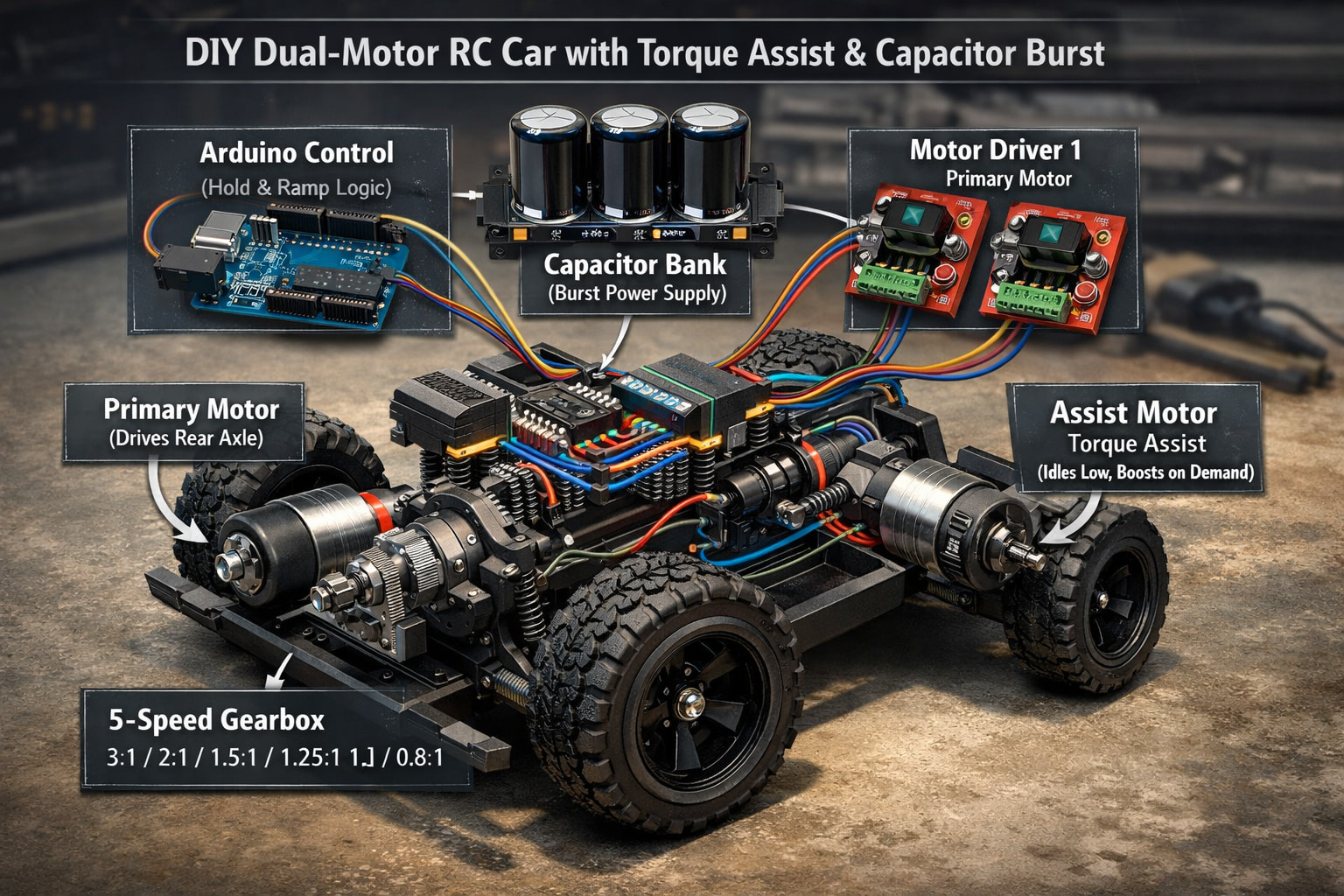
I’m working on a DIY RC car project and I’ve been developing the concept with the help of Microsoft Copilot (AI assistant). Together we’ve sketched out a design that combines a 5‑gear transmission with a dual‑motor torque assist system and a capacitor buffer for burst current.
Key design points:
-
Gear ratios: 3:1, 2:1, 1.5:1, 1.25–1.3:1, 0.7–0.8:1.
-
Primary motor: always drives the rear axle.
-
Secondary motor: mounted on the same rear axle, idles with small current to reduce drag, ramps up during gear transitions or heavy load.
-
Capacitor: added across battery rails to provide burst current during high torque demand, reducing strain on the battery.
-
Control logic: Arduino “hold then ramp” strategy for gear shifts, MOSFET/diode isolation for the assist motor to prevent back‑feeding.
What I’d like advice on:
-
Best way to mechanically couple two motors on the same rear axle.
-
Recommended capacitor type/size for burst current in RC setups.
-
Motor driver suggestions for dual‑motor control with isolation.
-
Any pitfalls to watch out for when running the assist motor at idle current.
I’d love to hear your thoughts, suggestions, or experiences with similar builds. Thanks in advance for helping me refine this project!
 Software Logic Overview (Arduino)
-
Primary Motor Control
-
Runs continuously based on throttle input.
-
Gear transitions use “hold then ramp” logic:
-
Hold motor speed briefly at top RPM of current gear.
-
Then gradually increase voltage/current to match next gear.
-
-
-
Assist Motor Control
-
Always receives a small idle current to reduce shaft resistance.
-
Arduino monitors speed, RPM, or current draw.
-
If torque demand spikes (e.g., gear shift, uphill, sudden acceleration):
-
Ramps up assist motor current smoothly.
-
Once speed stabilizes, drops back to idle current.
-
-
-
Capacitor Buffer Integration
-
Capacitor bank wired in parallel with battery.
-
Automatically discharges during high current demand (e.g., assist motor ramp).
-
Prevents voltage dips and reduces battery strain.
-