I am thinking of adding solar power and a small LiPo battery to my arduino nano every GPS project. It consists of an arduino nano every, Ublox GPS module, PiicoDev magnetometer and OLED, so no huge current-drawing devices.
This solar controller (DFR0559) looks pretty straightforward and affordable, but in terms of matching a panel that doesn’t exceed the 6V max input voltage seems more difficult. Most panels I see have a nominal voltage of 5 or 5.5V, but a maximum load voltage of 6.4V and open circuit voltage of 8-10V (like this one: SS313070005). I assume this means they can’t be used with this controller? Or is that under very specific circumstances and when no load (like the battery) is connected, so it will still be fine?
Solar Panel Voltage is tricky. I can confirm that a lot of solar panels race right into the maximum voltage rating relatively easily. For instance, this 0.5W Solar Panel:
Was recording 6.4V off a torch. An extremely bright torch, mind, quite close to the surface, but a torch nonetheless.
That being said, at the hobby and maker level, it’s somewhat worthwhile experimenting with different combinations to see what works for you. I have managed to get the above working well with the SPM, just not in direct sun.
Given panels will frequently go over the 5V max input, would you suggest placing some kind of a semi-transparent cover to artificially dim the input light if it is bright out?
After doing a bit more digging, I have also found this solar controller: ADA6106 which can take 5-18V DC input, so maybe this could be more suited? But maybe the charging current of 1A is too high for small LiPo batteries so I would need to ‘cut’ a pad on the back.
I have actually thought of another possible solution to the over-voltage problem. I have a 7-30V to 5V 4A buck converter I am not using. Maybe connecting the solar panel to that first, then the 5V output of the buck to the solar charger could circumvent over voltage.
However, this might result in efficiency / power loss. what do you think?
Hi Uan
Every time you convert there is a loss. Usually termed conversion efficiency and could be as bad as 85%. To estimate this convert everything to Watts for calculation purposes.
For example, I have a power bank rated at 1500 mAh. That is at the battery (3.7V). Conversion to 5V results in 11100mAhr. I don’t know what the conversion efficiency is but if I apply 85% as worst case i end up with about 9500mAhr which is the REAL capacity of my 15000mAhr power bank.
Mostly with reputable manufacturers of these conversion devices this conversion efficiency is published. Look in the Data sheet section where the graphs are.
Cheers Bob
Looking at the conversion efficiency for this buck converter, it is stated to be 90%, so I reckon that is pretty good. Given the device itself is very low power (maybe 150 mA total at a given time) even a modest LiPo battery would last a long time. I guess a downside to connecting the solar panel to a buck converter is if the light is too dim and the voltage drops below 7V, the panels won’t be able to charge the battery.
Alternatively as Jane mentioned, keeping the panel out of direct sunlight can keep the voltage down but I’m not too sure how repeatable that can be given if a cloud passes by what was previously a safe voltage could unexpectedly overload the charger.
Hi Euan
I use 85% as worst case. 90% is that bit better and I would consider a bonus. I personally would use 85% for estimation purpose to allow a bit of head room.
Cheers Bob
Honestly, @Euan284221, I don’t think keeping it out of direct sunlight is much of a solution, it’s more just working with the conditions of my house that happens to work out well for me.
I like the ADA6106, particularly this line from the product page ‘using a higher voltage panel will only lose the extra voltage as heat so there’s no benefit to going over 7V’. It’s good to know what’s happening with those higher voltages and as long as you’re not being insane with the solar panel voltages, you’ll be fine.
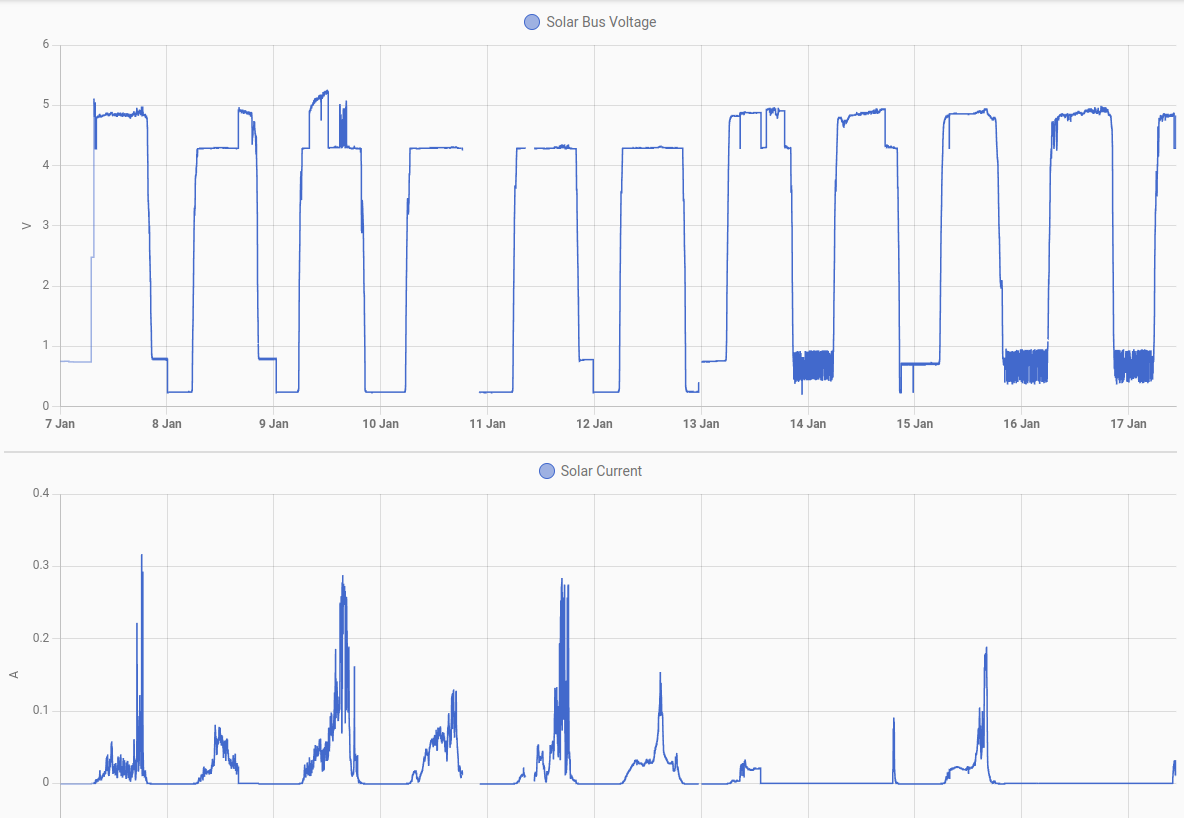
FWIW, I have had a couple of Solar Panels connected to a DFRobot Solar Power Manager 5V (DFR0559) and INA3221. Both give 4-5V when there is any light - but it is the amount of current which changes depending on time of day (angle of the sun) and cloud cover.
I first tried a 5V 4W regulated solar panel from AliExpress (which i think was intended for a security camera). Looking at the Solar Bus Voltage graph I saw that from dawn to sunset it generated >4V. Apart from one peak of 6.5V, the solar panel generated max 5.23V.
I later purchased a larger 5V 2A solar panel FIT0573 from Core … but again the voltage is fairly steady while the current varies. This panel may also have a voltage regulator built-in (I don’t remember)
One last question: a difference I am seeing between the sunflower controller and the adafruit one it the sunflower controller has a 5V usb output but the adafruit one has a normal regulated 5V output. Given the VIN of the nano every is 7-21V, that would mean using the 5V pin as a power input if I were to go for the adafruit controller.
Is that a safe way to power it? I traditionally only use VIN or the usb so would it be a good idea to connect the adafruit controller’s 5V output to the 5V pin on the every?
I believe the Every can be powered 3 ways. USB (5V), V IN (7-21V) or 5V Pin (external 5V)..
I have used a few of the NanoEvery boards and always powered with 5V on the 5V pin with no problems. If programming it can be powered via USB connector. If required the external 5V can be left connected to the 5V pin as there is an on board diode blocking any voltage feed back up the USB line.
So to answer your question (after all the background reasons) Yes, connect any external 5V to the 5V Pin. Not V IN Pin
Cheers Bob
Thank you so much, good to get that double-checked.
Out of curiosity, what about connecting the 5V and GND output of the controller to this: CE09241 USB A female breakout board and using the USB input on the every?
Probably nothing. All you would be doing is introducing another connector into the mix. Two connectors in fact as the USB cable will have one on each end.
In my humble opinion this will just add 2 more things that can give trouble. Particularly if the target environment is anyways on the harsh side.
What is often overlooked is connectors have a finite number of mating cycles where performance is guaranteed. Reputable manufacturers will publish these numbers. But if you are purchasing a cable with connectors from Ali Express or the like good luck finding that out. But in the experimental or hobbyist domain I think for domestic quality connectors this mating cycle figure could be easily exceeded.
For instance consider the humble D-Sub type. There must be many millions of these on various forms in service. The pins come in various forms, rolled, machined, 2 or 4 segments on the female, crimp, solder bucket and so on. Also various quality which mainly deals with the thickness of the gold plating.
The difference ?? Well an example (which I am not completely sure of now) the “domestic” quality is I think rated for 50 mating cycles while the “mil spec” versions are 200. Not a lot really. Of course they can operate sometimes well beyond that but that is the guaranteed figure published I think by Cannon. It is many years since I had any dealings with this sort of thing but I think you might get the idea.
Cheers Bob