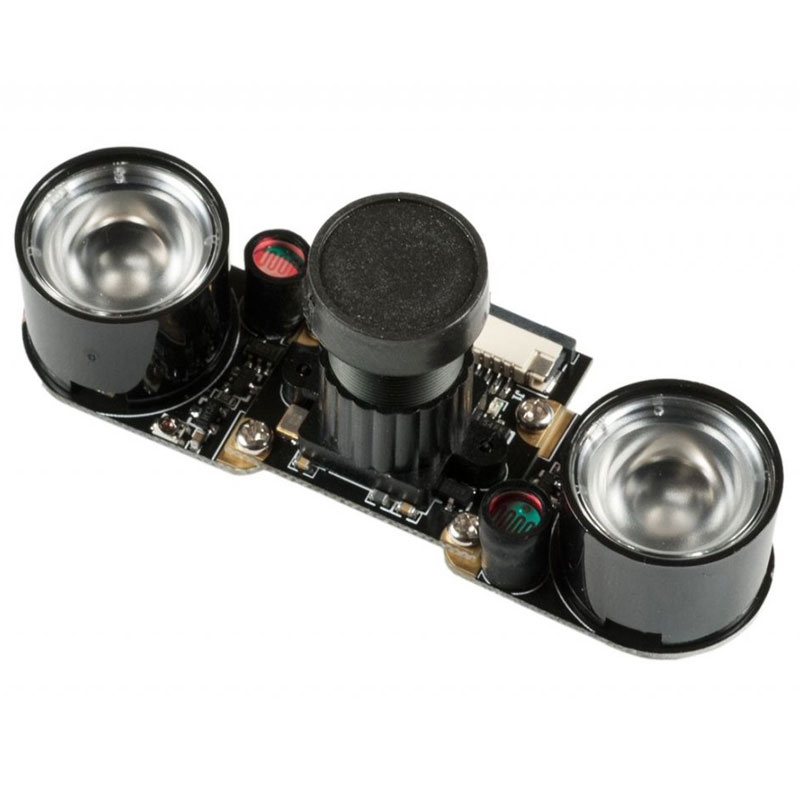
Yeah, It’s a decent quality piece of kit. Does what it says on the tin, only complaint would be there is no mount provided compared to other cheaper alternatives.
Easy to assemble and set up. And my favorite thing in Raspberry Pi Camera Night Vision Camera is Excellent HAT for Raspberry pi zero. no need for an extra USB to LAN converter.
Where exactly are potentiometers on the IR LEDs and how do you adjust them? My understanding is a potentiometer is a resistor, do they just dim the lights. The description infers that adjusting them will adjust when the LEDs turn on/off based on ambient light, which would be nice if it were true. At present, the light are always on, even in full daylight.
With these cameras, each IR LED module either side of the Camera board has its own Potentiometer. I grabbed a unit off the shelf and have labbeled the Potentiometer on the board in the picture below:
You can adjust this potentiometer with a Phillips head screwdriver and it should adjust the ambient light required to switch on the IR LEDs while the board is active and powered.
I’ve hooked up the camera to a pi zero 2w and added a PIR sensor. I’d ideally like to power the unit by battery or power pack so I can leave it outside overnight. I know the LEDs are power hungry so what power options do I have that could run this overnight? Thanks
Just a a quick reference to others, my Pi Zero 2W with this night vision board lasted about 8 hours from a 10K power bank. Also note that the output will have reddish tone due to it being an IR camera https://www.waveshare.com/wiki/RPi_Camera_(F)#FAQ
Thanks for circling back and sharing your findings, that kind of real-world info is super valuable and will no doubt be a great reference for others down the track. Appreciate you taking the time!
The ribbon cable (or any other for that matter) won’t “provide” anything. It is just the transport medium th convey power or whatever between points.
Cheers Bob
As noted further up on the thread by @Aaron, it’s probably not pulling 6W through the CSI, but it is still able to power the LEDs sufficient for its purpose. The Waveshare wiki for a very similar product, states the very unhelpful fact that wattage of the lamps will vary between 0.6W and 6.6W and that this varies based on the ambient light levels. The darker the environment, the more power it uses.
I went searching for some definitive statements re powering the LEDs but all I found were vague statements. Co-pilot seemed adamant that they have to be powered separately from the Pi (just based on math and Pi specs) but Co-pilot is adamant about a lot of things which is not the same as being correct.
I’ll hook them up as intended and test but I wonder if I’ll get the full 2 x 3W IR.